 Why Stretching Alone Isn’t Fixing Your Pain

Growing up playing basketball and running track, I was taught that stretching was the answer to everything.
Tight quads? Stretch.
Sore hamstrings? Stretch.
Something felt off before a game? Stretch harder and longer.
So I did. For years.
Then I finished my undergraduate studies. I was still active, still training, still stretching. But I was also sitting through classes and labs for hours at a time, and the pain kept showing up anyway. Same routine, same stretches, same problem.
It wasn’t until I got deeper into my clinical studies that it finally made sense. Stretching was never the wrong thing to do. It just was never going to be enough on its own.
What Does Stretching Actually Do?
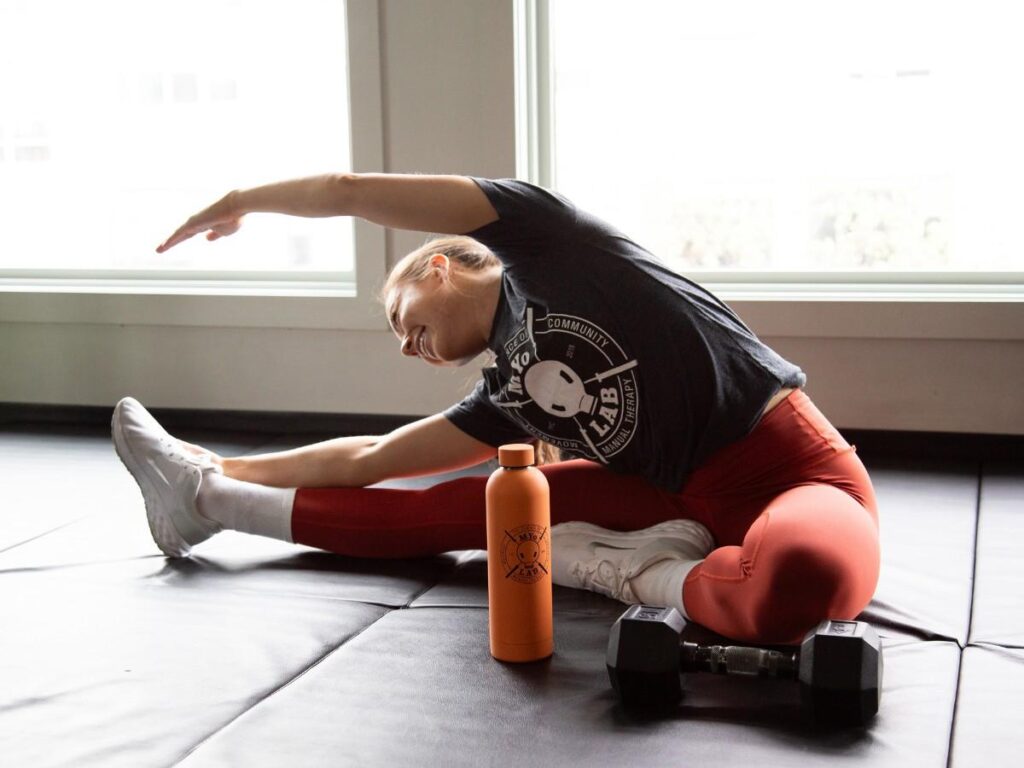
Most people assume stretching makes a muscle physically longer. The research says something different.
When you stretch consistently and gain range of motion, the main change is how much stretch your nervous system will tolerate, not the tissue’s actual length. Your body becomes more comfortable in a position it used to resist.
That’s useful. But notice what it does not do:
- It does not build strength in the new range you just gained
- It does not teach your body to control that range under load
- It does not change the movement habits that created the tightness
So you gain range, feel better for an hour or two, and by the next day the tightness is back.
That’s not a failure on your part. That’s what happens when you open a door and never walk through it.
Why Does Tightness Keep Coming Back?
Here’s the part that took me the longest to understand.
Tightness is often a symptom, not the problem. Muscles often tighten because they are protecting something, compensating for something, or working overtime for a muscle that isn’t doing its job.
A few common examples:
- Chronically tight hamstrings in someone whose glutes are not contributing to hip extension
- Tight hip flexors in someone who sits for long hours and has lost lumbopelvic control
- Tight upper traps in someone with poor scapular stability
In each case, stretching the tight muscle addresses the loudest symptom and leaves the actual driver untouched. The muscle tightens again because the demand that created the tightness has not changed.
What Does Research Say About Stretching for Injury and Pain?
The evidence here is fairly consistent, and it surprised me when I first read it.
Stretching before or after exercise has not been shown to meaningfully reduce muscle soreness or injury risk. Prolonged static stretching immediately before activity can also reduce force output and power in the short term, with larger deficits when each muscle group is held for 60 seconds or more.
Strength training, on the other hand, has strong evidence behind it. A meta-analysis of randomized controlled trials found that strength training reduced sports injury rates to under a third, while stretching protocols showed no meaningful protective effect. For hamstring injuries specifically, adding eccentric strengthening reduced injury rates by up to 51 percent across more than 8,000 athletes.
Key takeaway: Stretching helps you access range.
Strength helps you keep it and use it safely.
So, Should You Stop Stretching?
No. And this is where we want to be clear, because the pendulum tends to swing too far in the other direction.
Stretching is a foundation. It’s a starting point. It creates the window of opportunity that everything else builds on. The mistake is treating the foundation as the finished house.
At MYo Lab, stretching sits inside our three-phase framework: release, stabilize, strengthen.
- Release is where stretching lives, alongside chiropractic care and massage therapy. The goal is to restore access to a range of motion your body has lost.
- Stabilize is where you learn to control that new range. Low load, high control work that teaches the right muscles to switch on at the right time.
- Strengthen is where the change becomes permanent. Progressive loading through the full range so your body has a reason to keep it.
Skip the second and third phases and you end up doing what I did for years. Stretching, feeling temporary relief, and wondering why nothing changed.
What Should You Do Instead?
If stretching has been your primary strategy and your symptoms keep returning, the answer is usually not more stretching. It’s finding out what the tightness is protecting.
That means:
- Identifying which muscles are actually underperforming
- Understanding what movement patterns are driving the compensation
- Building strength and control through the range you are trying to keep
This is exactly what a proper exercise rehabilitation assessment is for. Not a generic stretch routine, but a clear picture of what your body is doing and why.
Ready to Stop Chasing the Same Tightness?
If you’ve been stretching the same muscle for months or years without lasting change, that is useful information. It usually means the tightness is downstream of something else.
An assessment at MYo Lab will identify what that something else is and give you a plan that goes past the foundation.
Book an appointment with Dr. Rahul Yadav, a movement-based clinician with a strong athletic background whose approach lies in exercise rehabilitation and performance-focused care.
You can also call us at (403) 930-8686 or email us at info@myolab.ca for additional information.
We’re conveniently located 5 minutes from Sunnyside C-Train with complimentary parking.
Written & fact-checked by Dr. Rahul Yadav, DC, MSc.
 Related Articles