
 Desk Job? Here’s Why Your Body Feels Worse Than It Should
I’ve spent seven years studying. That means seven years of long hours hunched over textbooks, laptops, and lecture notes.
By the end of it, I knew exactly what was happening to my body, and I still struggled to counter it. So when patients come into the clinic describing neck tension, low back stiffness, and that heavy, achy feeling that shows up by mid-afternoon, I understand it personally, not just clinically.
What I see most often in desk workers is not a dramatic injury. It’s the slow accumulation of small stresses on a body that was never designed to sit still for hours at a time. And by the time pain shows up, the problem has usually been building for much longer than you realize.
Why Sitting Feels So Harmless (But Isn’t)
Let’s compare it to intense thirst. By the time you feel thirsty, your body is already dehydrated. The sensation is lagging behind the problem.
Pain works the same way.
By the time your neck or back is signalling distress, the microtraumas have been accumulating for weeks, months, and sometimes even years.
Every hour of sustained sitting loads your spine, compresses your discs, shortens your hip flexors, and gradually switches off the muscles responsible for keeping you upright (McGill, 2007). None of this feels like much in the moment. But over time, these small repeated stresses add up. Your desk job is not creating a new problem so much as it is exposing and accelerating an underlying one.
What Are Microtraumas and Why Do They Matter?
A microtrauma is a small, subclinical stress to a tissue that does not cause immediate pain or damage but accumulates over time (Solomonow et al., 2003). Think of it like bending a paperclip. Once is fine. A hundred times and it snaps.
For desk workers, microtraumas happen constantly:
- Sustained forward head posture loads the cervical spine with forces far beyond what upright posture would (Hansraj, 2014)
- Prolonged hip flexion shortens the psoas and iliacus muscles, altering pelvic position and lumbar loading
- Sustained thoracic flexion reduces the ability of the mid-back to extend, shifting load to the neck and lower back
- Static muscle activation without movement reduces blood flow and accelerates tissue fatigue (McGill, 2007)
Individually, none of these are catastrophic. Together, sustained over a full working day…repeated five days a week…for years, they create the conditions for pain, dysfunction, and injury.
Is It Really Just a Posture Problem?
Poor posture is often blamed as the root cause of desk-related pain. But posture is a symptom, not the diagnosis.
What actually drives the problem is the combination of sustained load, reduced movement variability, and progressive deconditioning of the muscles that support your spine and joints (O’Sullivan et al., 2018). Your body is not failing because you sit wrong. It’s struggling because it sits too much, moves too little, and has lost the capacity to manage the demands being placed on it.
I see this constantly at the clinic. Office workers come in with neck pain or low back stiffness that seems to have appeared out of nowhere. When we dig into their history, the pattern is almost always the same. Years of accumulated microtrauma, a capacity deficit that has been quietly growing, and then one day a long flight, a stressful week, or a slightly awkward movement tips the balance.
The desk job did not cause the injury. It accelerated what was already there.
What Happens to Your Body During a Full Work Day?
Here is what a typical eight-hour desk day actually does:
- Your hip flexors shorten, and your glutes progressively switch off, altering how load is distributed through your pelvis and lumbar spine
- Your deep cervical flexors fatigue, allowing your head to drift forward and increasing the load on your upper traps and cervical extensors
- Your thoracic spine stiffens in flexion, reducing rotation and extension capacity and forcing your neck and lower back to compensate
- Your intervertebral discs experience sustained compressive load without the movement needed to promote fluid exchange and nutrient delivery (Adams & Dolan, 2005)
- Your nervous system adapts to the sustained position, gradually recalibrating what it perceives as normal, which makes correcting it later harder
By the time you stand up at the end of the day, your body has been managing hours of accumulated stress. The stiffness, tension, and fatigue you feel are not weakness. It’s your body telling you the bill has come due.
What Does Recovery Actually Look Like?
The good news is that the body is highly adaptable. The same capacity for change that allowed these problems to develop can be redirected toward resolving them with the right approach.
At MYo Lab, the approach to desk-related pain through exercise rehabilitation focuses on three things:
- Restoring the mobility that sustained sitting has taken away, particularly through the hips, thoracic spine, and cervical spine
- Rebuilding the stabilizing capacity of the muscles that prolonged sitting has switched off, particularly the deep neck flexors, glutes, and lumbar stabilizers
- Progressively loading those muscles so they can handle the demands of a full work day without breaking down
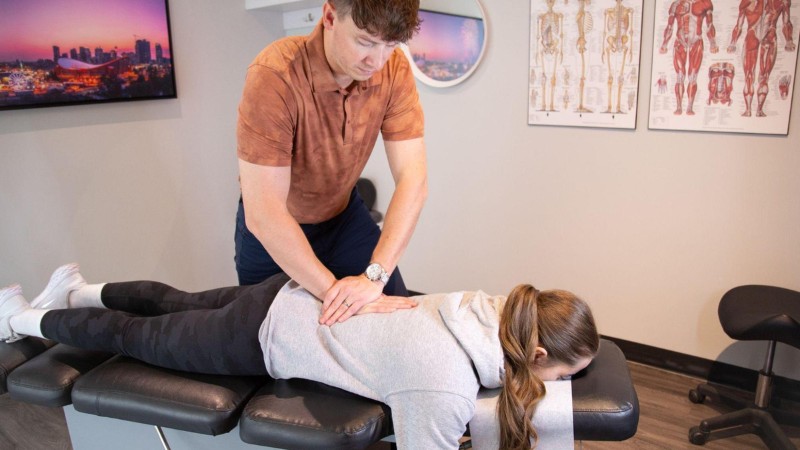
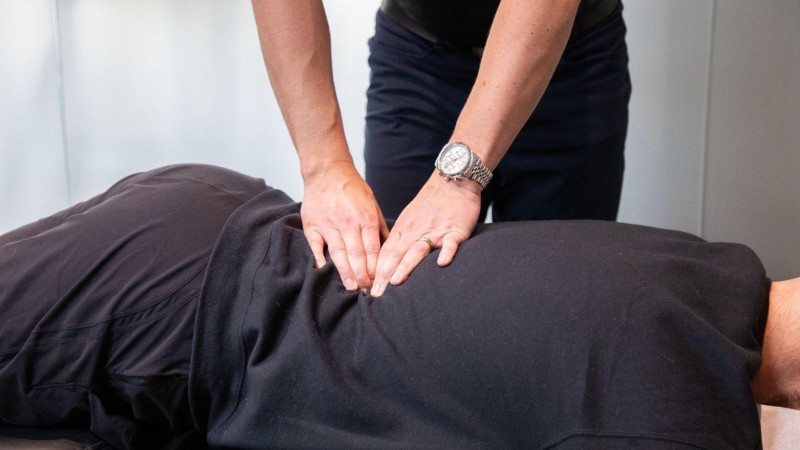
This is coordinated with chiropractic care to address joint restrictions that have developed over time, and massage therapy to manage the tissue tension that accumulates in overworked muscles.
What Can You Do Right Now?
You do not need to wait until the pain becomes unbearable. The earlier you address it the better, because the longer microtraumas accumulate without intervention, the more capacity deficit you are working against.
A few things that make a meaningful difference:
- Move every 30 to 45 minutes. Even two minutes of standing and walking breaks the sustained load cycle
- Prioritize thoracic extension and hip flexor lengthening as part of a daily movement routine
- Strengthen your posterior chain, glutes, hamstrings, and mid-back, which are the muscles most suppressed by prolonged sitting
- Get a proper assessment so you know exactly what your body needs, not a generic stretch routine
Is Your Body Telling You Something?

If you’re dealing with tension, stiffness, or recurring pain that seems connected to your work routine, it’s worth taking seriously. Not because something is badly wrong, but because the longer microtraumas accumulate without a plan, the harder the recovery becomes.
A thorough assessment at MYo Lab will identify exactly where your capacity deficits are, what’s driving your symptoms, and what a realistic plan forward looks like.
Book an appointment with Dr. Rahul Yadav, a movement-based clinician with a strong athletic background whose approach lies in exercise rehabilitation and performance-focused care.
You can also call us at (403) 930-8686 or email us at info@myolab.ca for additional information.
We’re conveniently located 5 minutes from Sunnyside C-Train with complimentary parking.
Written & fact-checked by Dr. Rahul Yadav, DC, MSc.
 Related Articles